

Synthetic data has the potential to support better, faster, and more equitable health policy by enabling safe access to data for analysis, modelling, and decision-making — without exposing identifiable personal information. For policymakers, it offers a complementary tool to strengthen evidence generation, improve system planning, and support responsible innovation in AI-enabled healthcare.
SYNTHIA works with policymakers and public authorities to ensure that synthetic data is developed and used within clear governance frameworks that align with European values, legal standards, and public trust.
What does synthetic data mean for policymaking
Synthetic data refers to artificially generated data that reproduces the statistical structure and relationships of real-world data while reducing risks associated with sharing patient-level information. In health policy contexts, it can support analysis across clinical, population, and system-level data where direct access to real data is constrained by privacy, fragmentation, or scale. Importantly, synthetic data is not inherently “risk-free.” Its value depends on how it is generated, validated, governed, and used. For policymakers, this means focusing on fitness-for-purpose, proportional safeguards, and transparency, rather than treating synthetic data as a one-size-fits-all solution.
Why synthetic data matters for policymakers
Enables evidence-informed policy
Synthetic data can support health system modelling, policy impact assessment, and public health planning by enabling access to realistic datasets that are otherwise difficult to use in a timely or scalable way.
Strengthens privacy-preserving governance
By decoupling analysis from identifiable records, synthetic data can reduce disclosure risks and facilitate cross-border and cross-sector collaboration, when accompanied by appropriate assurance and oversight.
Addresses data gaps and inequities
Synthetic data can help explore underrepresented populations, rare conditions, and small subgroups that are often missing from traditional datasets, supporting more inclusive policy analysis when bias and representativeness are actively assessed.
Supports preparedness and system resilience
Synthetic datasets can be used to test scenarios, simulate system responses, and support preparedness planning without placing additional burdens on health systems or individuals.
Trust, governance and responsible use
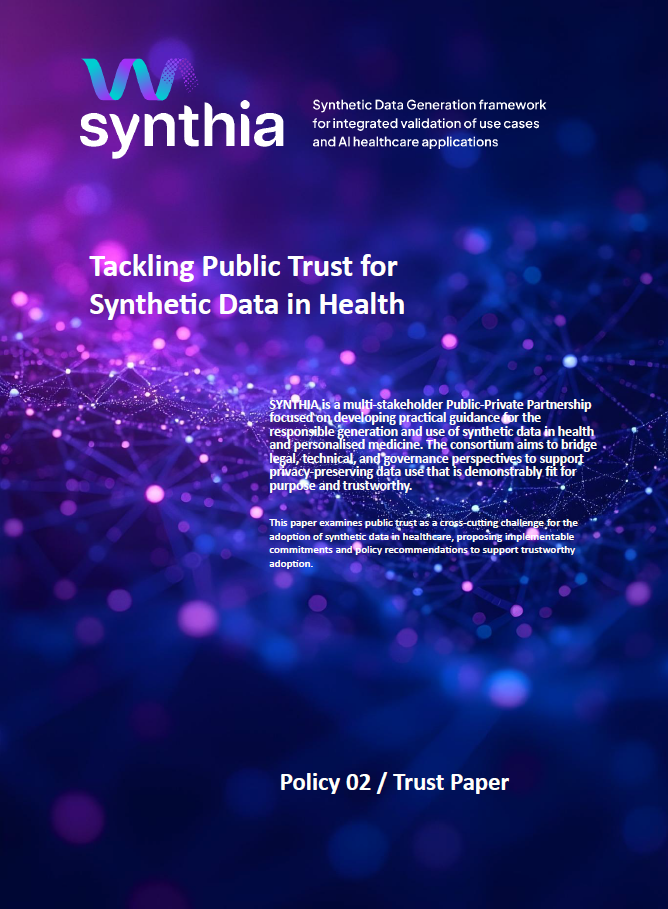
Public trust in synthetic data cannot be assumed simply because data is artificially generated. Trust is an outcome of robust validation, clear accountability, and meaningful transparency. SYNTHIA therefore approaches synthetic data as a governed public capability, not a technical shortcut — applying safeguards proportionate to the risk and stakes of use, and recognising that higher-impact policy applications require stronger scrutiny. Ethical, legal and societal considerations are embedded throughout the data lifecycle, with transparency and participation treated as prerequisites for legitimacy, not afterthoughts. This trust-centred approach is essential to ensure that synthetic data strengthens, rather than undermines, confidence in health data use and AI-supported policymaking.
SYNTHIA’s contribution to policy development
SYNTHIA supports policymakers by translating technical advances in synthetic data into policy-relevant guidance and evidence. This includes analysing the policy opportunities and limitations of synthetic data use, aligning with EU frameworks such as the GDPR, the AI Act, the European Health Data Space and Health-in-All-Policies approaches, and developing governance and assurance concepts to support responsible uptake. SYNTHIA also produces policy briefs and recommendations to inform decision-making at both national and European level. Through this work, SYNTHIA aims to support coherent, evidence-based approaches to synthetic data across health systems and borders.
Expected impact for policymakers
By the end of the project, SYNTHIA aims to improve policy understanding of when and how synthetic data can be used responsibly, and to contribute evidence and guidance for governance and standard-setting. This includes supporting safer, data-driven policy analysis and planning, and strengthening public trust in privacy-preserving health data innovation. Synthetic data is not a replacement for real-world evidence, but, when governed responsibly, it can be a valuable complement in modern health policymaking.
Turning Synthetic Data Innovation into Policy and Practice
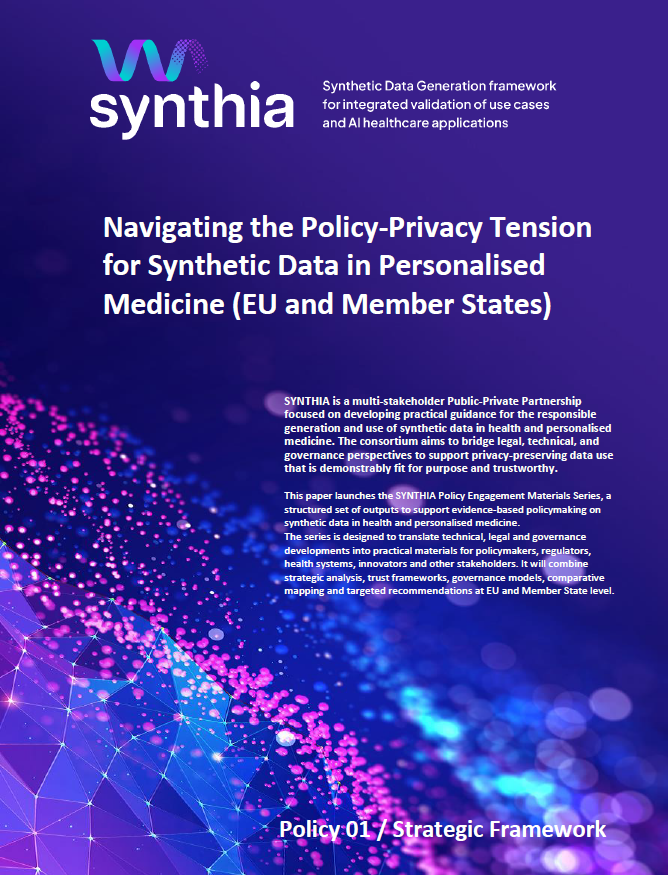
The SYNTHIA Policy Engagement Materials translate advances in synthetic data into practical, policy-relevant insights to support responsible use in health research and policymaking. Through a series of papers and recommendations, SYNTHIA explores the opportunities and limitations of synthetic data, its relationship with evolving EU legislation, and the governance, assurance and transparency needed to build public trust. Topics include risk-based governance models, health data access pathways, synthetic control arms and differences in implementation across EU Member States, helping bridge the gap between regulatory principles and responsible practice.
Explore the first two papers in the series below to learn more about emerging policy needs, opportunities and key considerations for creating a trustworthy and enabling environment for the use of synthetic data in European health research and innovation.
Let’s Connect
SYNTHIA engages with policymakers and public authorities at national and European level. We welcome dialogue on how synthetic data can support health policy priorities while maintaining high standards of ethics, transparency, and accountability.
Reach out to our SYNTHIA to share your thoughts send an email to: contact@ihi-synthia.eu
