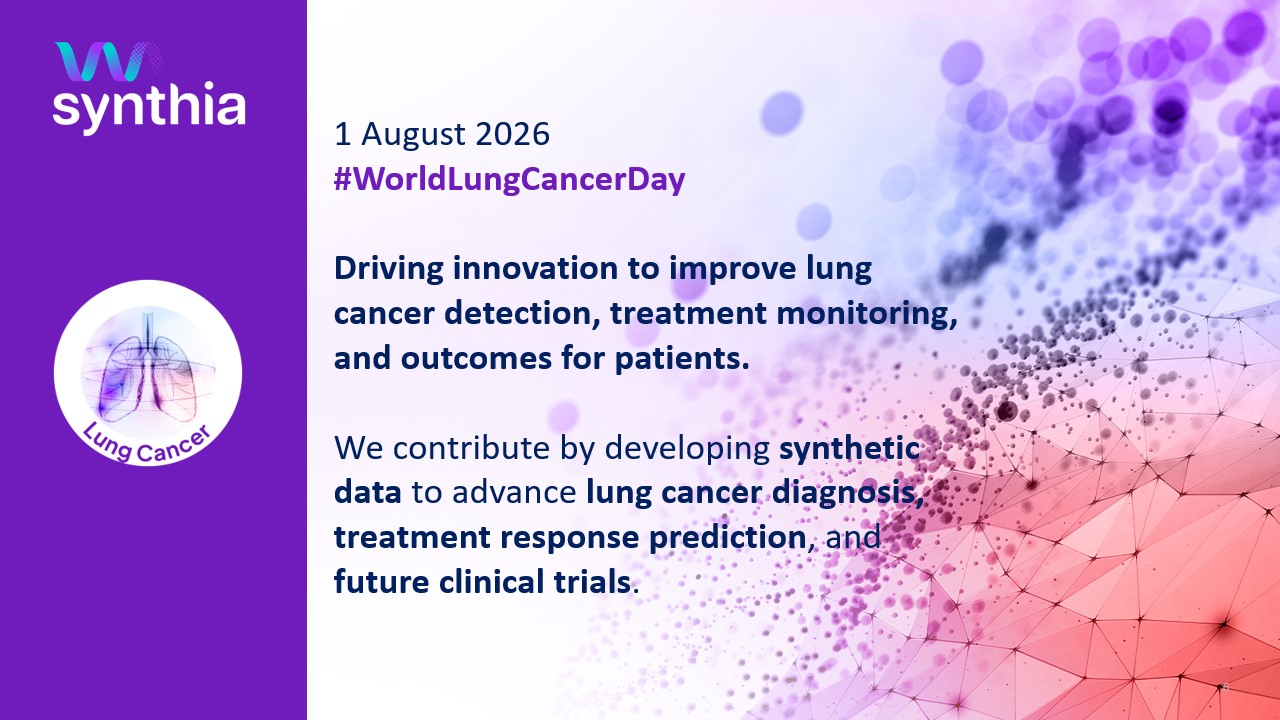

On World Lung Cancer Day, SYNTHIA joins the global community in raising awareness and driving progress for people affected by lung cancer — through research, innovation and collaboration.
Lung cancer remains the leading cause of cancer-related deaths in Europe, accounting for around one in five cancer deaths. Despite significant advances in diagnosis and treatment, many patients are still diagnosed at an advanced stage, while predicting treatment response and disease progression remains a major challenge. Accelerating progress requires access to large, diverse, high-quality datasets, yet privacy concerns and limited data availability often restrict research and innovation.
Improving Lung Cancer Research with Synthetic Data
At SYNTHIA, our research teams are exploring how synthetic data can help overcome these challenges by generating realistic, privacy-preserving datasets that reflect the characteristics of real patient data without exposing sensitive information.
The lung cancer use case combines imaging data, including CT and PET-CT scans, with electronic medical records and clinical information to develop and validate new synthetic data generation methods. These datasets enable researchers to investigate how synthetic data can support the development of more accurate and reliable AI models while maintaining patient privacy.
Research within this use case focuses on:
- Predicting tumour aggressiveness and treatment response using synthetic imaging and clinical data
- Improving models for survival prediction, disease progression and relapse
- Developing synthetic lung nodules and enhanced medical images to improve lesion detection, segmentation and treatment monitoring
- Exploring synthetic external control arms for clinical trials to support more efficient evidence generation and future regulatory and health technology assessment decision-making
Supporting More Personalised Care
Synthetic data has the potential to transform how lung cancer research is conducted. By enabling secure data sharing across institutions, researchers can build and validate AI models using larger and more representative datasets while reducing barriers created by privacy regulations.
The work carried out in SYNTHIA also aims to strengthen radiogenomic research by linking imaging features with molecular information, supporting more personalised treatment strategies and improving predictions of patient outcomes. At the same time, synthetic data can help reduce dependence on sensitive patient images while maintaining the quality needed for research and innovation.
Building the Future of Lung Cancer Research
Advancing lung cancer research requires innovative technologies that enable collaboration without compromising patient trust. Through the development and validation of synthetic data technologies, SYNTHIA is helping create new opportunities for earlier diagnosis, improved treatment monitoring, more efficient clinical trials and better outcomes for patients living with lung cancer.
On World Lung Cancer Day, we reaffirm our commitment to developing trustworthy synthetic data solutions that support researchers, clinicians and healthcare decision-makers while placing patients at the centre of innovation.
- Learn more about SYNTHIA’s work in synthetic data research on our impact and publications page.
- Read more on how ethical, legal and societal issues play a central role in connecting with citizens and patients here.