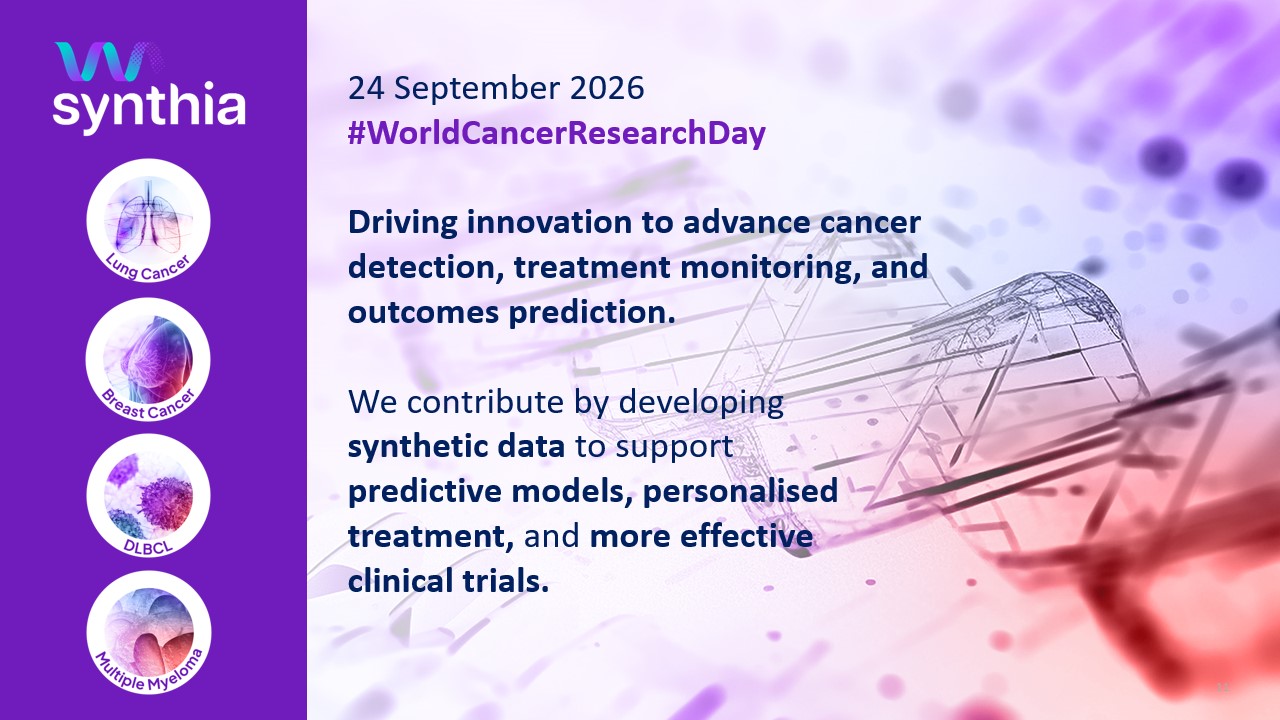

On World Cancer Research Day, SYNTHIA joins the global community in highlighting the importance of continued research, collaboration and innovation to advance cancer prevention, diagnosis, treatment and care.
Cancer remains one of the most significant health challenges worldwide. While advances in research have transformed how many cancers are detected, treated and managed, important challenges remain – from diagnosing cancer earlier and predicting how individual patients will respond to treatment to generating robust evidence for new therapies.
At SYNTHIA, four of our six clinical use cases focus on cancer: lung cancer, breast cancer, Multiple Myeloma (MM) and Diffuse Large B-Cell Lymphoma (DLBCL). Across these use cases, researchers are exploring how synthetic data can help overcome data-related barriers and support new approaches to cancer research.
Addressing Data Challenges in Cancer Research
Modern cancer research increasingly relies on large, diverse and high-quality datasets. Combining information from medical imaging, electronic health records, laboratory results, genomics, pathology and other sources can help researchers better understand disease progression, identify patterns and develop models for diagnosis, treatment response and patient outcomes. However, access to these data can be limited. Cancer datasets may be fragmented across institutions, difficult to share due to privacy and ethical considerations, or too small to adequately represent particular patient populations and disease characteristics. Differences in data formats and quality can create additional challenges.
Synthetic data offers a promising approach to complement existing health data by generating artificial data that reflect important characteristics and patterns of real-world data while supporting patient privacy.
Across its four cancer use cases, SYNTHIA is investigating how synthetic data can support predictive modelling, medical imaging, treatment response prediction and clinical trials, while assessing its quality, utility and suitability for different healthcare applications.
The SYNTHIA Lung Cancer Use Case

Lung cancer remains a major global health challenge, with outcomes often affected by late diagnosis, recurrence and the need for reliable biomarkers to support treatment decisions.
Through its Lung Cancer, SYNTHIA is exploring how synthetic imaging and clinical data could contribute to better detection, treatment monitoring and outcome prediction. The research focuses on several areas:
- Investigating whether tumour aggressiveness and response to different treatments can be predicted using models trained on synthetic CT and electronic medical record data.
- Exploring synthetic data to improve models for overall survival, progression-free survival and relapse prediction.
- Developing synthetic lung nodules and imaging data to support lesion detection, segmentation and other downstream imaging tasks.
- Combining imaging, clinical and biomarker information to explore more personalized approaches to treatment and disease monitoring.
- Investigating synthetic external control arms to support evidence generation for clinical trials.
Ultimately, the research aims to demonstrate how synthetic data can support earlier and more accurate detection, better monitoring of disease progression and treatment response, and improved prediction of patient outcomes.
The SYNTHIA Breast Cancer Use Case

Breast cancer is the most prevalent cancer among women in Europe. Early detection through breast imaging is critical, but research and innovation can be constrained by limited access to large, high-quality datasets combining imaging, clinical, genomic and pathological information.
SYNTHIA's breast cancer use case is investigating how synthetic data could improve breast cancer detection and characterization, treatment response prediction and clinical trial design. The work includes:
- Creating synthetic breast tissue and lesion models using advanced generative AI methods to support automated detection, imaging harmonization and other imaging applications.
- Validating multimodal AI models for predicting treatment response and relapse using both real and synthetic data.
- Assessing prognostic performance, potential bias and generalizability when synthetic data are incorporated into predictive models.
- Generating synthetic data to strengthen external control arms in clinical trials evaluating new breast cancer therapies.
By bringing together mammography, MRI, ultrasound, clinical and epidemiological information, radiomics, genomics and pathology, the research aims to support more accurate diagnosis, better-informed treatment allocation and stronger evidence generation.
The SYNTHIA Multiple Myeloma Use Case

Multiple Myeloma is the second most prevalent haematological cancer. Although treatment options and clinical outcomes have improved substantially, the disease remains incurable, and its considerable genetic heterogeneity continues to create challenges for treatment and research.
SYNTHIA's Multiple Myeloma use case explores how synthetic data can support external control arms and improve long-term outcome prediction. The research focuses on:
- Evaluating how accurately synthetic data can reproduce clinical characteristics and outcomes observed in clinical trials and real-world datasets.
- Exploring the integration of genomic, clinical, demographic, therapeutic and imaging information into synthetic datasets.
- Investigating how synthetic genomic data can help researchers study rare, high-risk genetic alterations and their relationship with clinical outcomes.
- Assessing the potential of synthetic external control arms to contribute evidence for regulatory and Health Technology Assessment decision-making.
By integrating diverse sources of information, the use case aims to strengthen predictive modelling, contribute to precision medicine and explore new ways of generating evidence for the development and evaluation of Multiple Myeloma treatments.
The SYNTHIA DLBCL Use Case

Diffuse Large B-Cell Lymphoma (DLBCL) is the most common form of non-Hodgkin lymphoma. Although effective first-line treatments are available, some patients experience relapse or develop refractory disease, creating a continued need for better ways to predict treatment response and evaluate new therapies.
Through its Diffuse Large B-cell Lymphoma, SYNTHIA is investigating how synthetic data could contribute to both clinical trial design and prognostic modelling. The research includes:
- Generating synthetic data to strengthen external control arms for clinical trials and validating them against retrospective real-world data.
- Developing and validating prognostic models based on Minimal Residual Disease (MRD), an important indicator of treatment response and patient outcomes.
- Exploring whether synthetic data can improve the pre-training of AI models for lesion segmentation and identification.
- Expanding available DLBCL cohorts and investigating how synthetic data can help account for treatment-related variability when evaluating MRD.
Using MRD data alongside clinical and laboratory information, demographics, treatment data and PET-CT imaging, the research aims to improve disease monitoring and treatment response prediction while strengthening evidence generation for new therapies.
From Better Data to Better Cancer Research
Although each cancer presents different clinical and research challenges, SYNTHIA's four cancer use cases share a common goal: exploring how trustworthy synthetic data can help researchers make better use of complex health data and generate stronger evidence. Across lung cancer, breast cancer, Multiple Myeloma and DLBCL, this means investigating applications ranging from cancer detection and lesion identification to treatment response and outcome prediction, disease monitoring and external control arms for clinical trials.
Importantly, synthetic data are not being explored in isolation. SYNTHIA brings together expertise from healthcare, academia, industry, technology, regulatory science, Health Technology Assessment and patient engagement to investigate not only how synthetic data can be generated, but also how their quality, utility and trustworthiness can be evaluated for different applications.
On World Cancer Research Day, we recognize the researchers, healthcare professionals, patients and communities contributing to progress in cancer research worldwide.
Through SYNTHIA, we are working towards a future where responsible data innovation can help strengthen cancer research, enable more personalized approaches to care and, ultimately, contribute to better outcomes for people affected by cancer.
- Learn more about SYNTHIA's work across our six clinical use cases.
- Discover more about SYNTHIA's synthetic data research on our impact and publications page.
- Read more about how ethical, legal and societal considerations are incorporated into SYNTHIA's engagement with citizens and patients here.