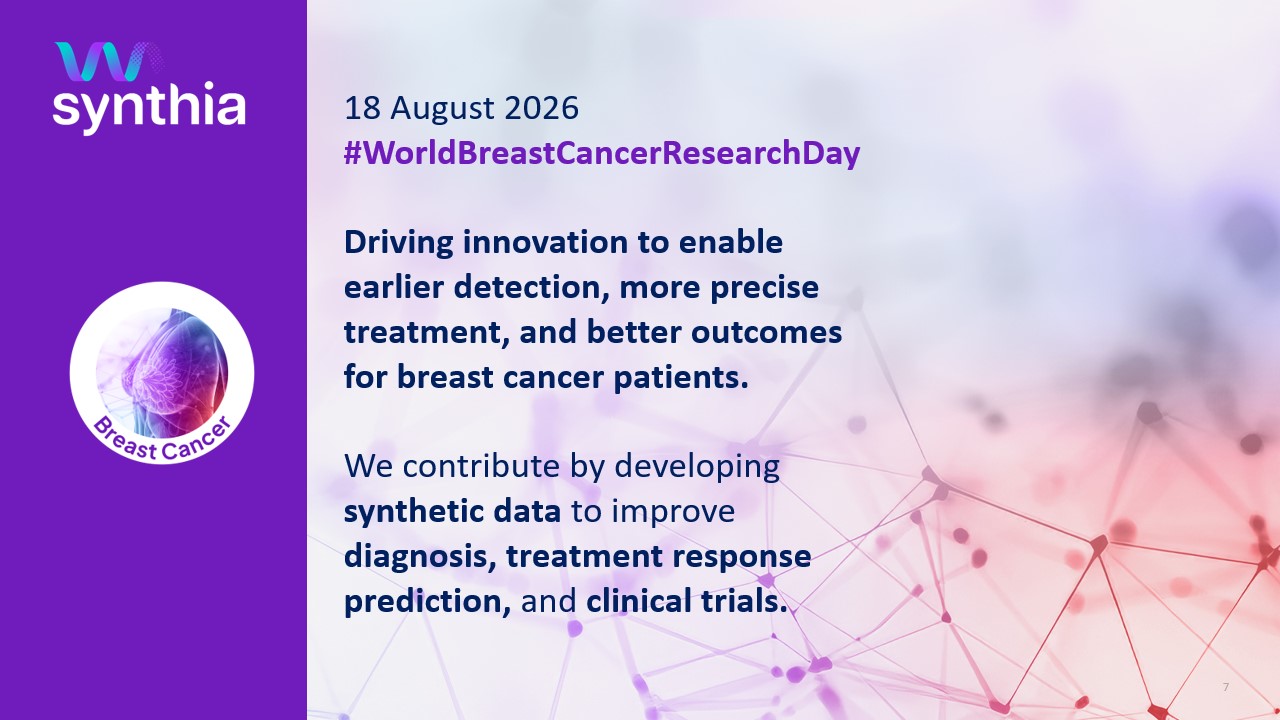

On World Breast Cancer Research Day, SYNTHIA joins the global community in recognizing the importance of continued research and innovation to improve breast cancer detection, treatment and outcomes.
Breast cancer remains the most prevalent cancer among women in Europe, accounting for more than 30% of newly diagnosed cancers. Globally, more than 2.3 million new cases occur each year, highlighting the continued need for research that can support earlier detection, more personalized treatment and better outcomes for patients.
Addressing Data Challenges in Breast Cancer Research
Early detection through breast imaging is vital, but developing and validating new tools requires access to large, diverse and high-quality datasets. In breast cancer research, however, access to multimodal data combining imaging, clinical, genomic and pathological information remains limited. Privacy and ethical considerations, interoperability challenges and fragmented datasets can further restrict how health data are accessed and shared for research.
Synthetic data offers a promising way to address these challenges, enabling researchers to create artificial data that reflect important characteristics of real-world data while supporting patient privacy.
The SYNTHIA Breast Cancer Use Case
Through its dedicated Breast Cancer use case, SYNTHIA is investigating how synthetic data can support innovation across breast cancer diagnosis, treatment and clinical research.

Our work focuses on three key areas:
- Improving detection and characterization by developing advanced synthetic breast tissue and lesion models that can support imaging and automated detection tasks.
- Predicting treatment response and relapse by developing and validating multimodal AI models using real and synthetic data, while assessing performance, bias and generalizability.
- Supporting innovative clinical trials by generating synthetic data to strengthen external control arms, with the potential to reduce reliance on conventional randomized standard-of-care control groups.
The Breast Cancer use case brings together multiple types of health data, including mammography, MRI, ultrasound, radiomics, genomics, pathology, and clinical and epidemiological data.
- Learn more about SYNTHIA’s Breast Cancer use case
From Better Data to Better Decisions
By combining synthetic data with advanced AI approaches, SYNTHIA aims to improve the accuracy and efficiency of automated breast cancer detection, staging and follow-up.
SYNTHIA also seeks to support more personalized clinical decision-making by improving models that predict treatment response and relapse. At the same time, synthetic control arms could contribute to more efficient clinical trial designs and strengthen evidence available to regulators, Health Technology Assessment bodies, healthcare providers and, ultimately, patients.
On World Breast Cancer Research Day, we highlight the importance of continuing to invest in research and responsible data innovation to advance our understanding of breast cancer and translate scientific progress into better care.
Through SYNTHIA, we are working towards a future where synthetic data can help researchers make better use of health data, accelerate innovation and contribute to more personalized approaches to breast cancer diagnosis and treatment.
- Learn more about SYNTHIA’s work in synthetic data research on our impact and publications page.
- Read more on how ethical, legal and societal issues play a central role in connecting with citizens and patients here.