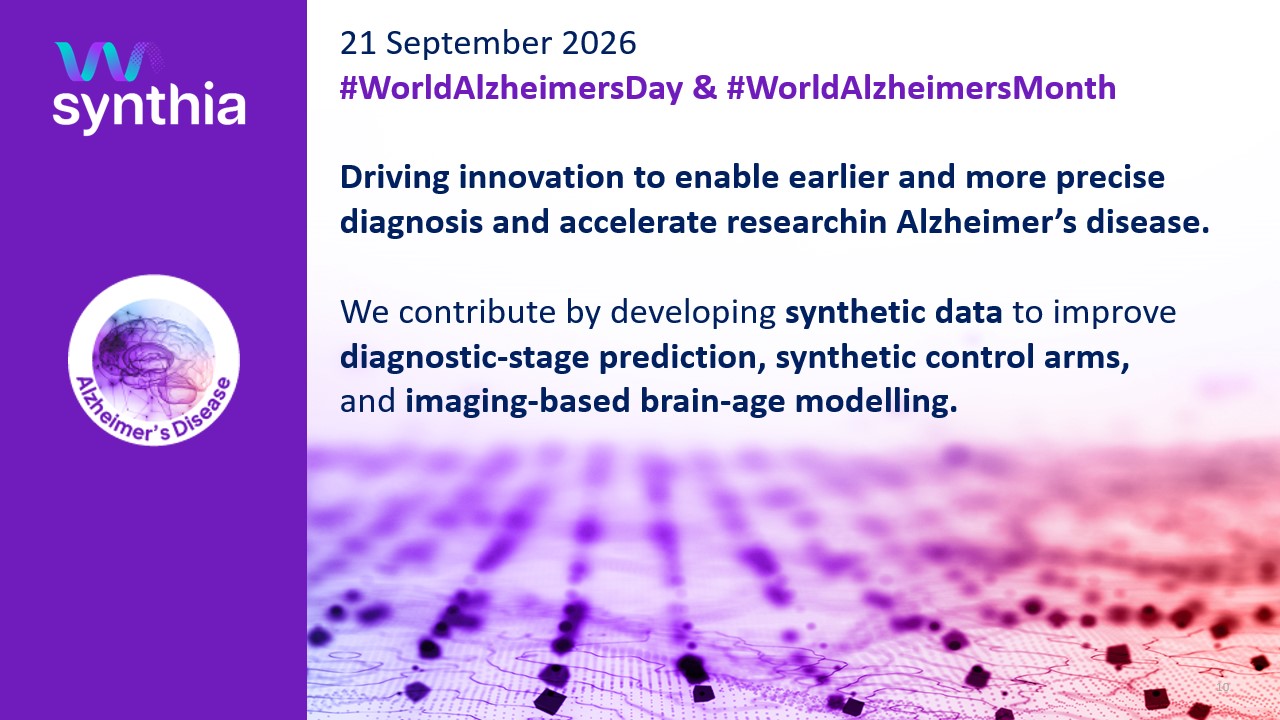

On World Alzheimer’s Day, observed during World Alzheimer’s Month, SYNTHIA joins the global community in raising awareness of Alzheimer’s disease and highlighting the importance of continued research and innovation to support earlier diagnosis, more effective clinical research and better outcomes for patients.
Alzheimer’s disease is the leading cause of dementia, and its prevalence continues to rise as populations age. Changes associated with the disease can begin years before symptoms become apparent, making earlier and more precise detection an important but complex challenge.
Addressing Data Challenges in Alzheimer’s Research
Alzheimer’s disease is characterized by progressive changes in the brain and neuronal loss that can begin long before noticeable symptoms emerge. Distinguishing between different cognitive stages, from cognitively normal to mild cognitive impairment and dementia, can be challenging due to the complexity and heterogeneity of the disease. Research and diagnosis increasingly draw on different sources of information, including neuroimaging, fluid biomarkers, genetic data and neuropsychological assessments. However, some diagnostic tests can be costly or invasive, while access to the large, diverse and longitudinal datasets needed to develop and validate new approaches can be constrained by privacy, accessibility and data-sharing challenges.
Synthetic data offers a promising approach to help address some of these challenges by creating artificial data that reflect important characteristics of real-world health data while supporting patient privacy.
The SYNTHIA Alzheimer’s Disease Use Case
Through its dedicated Alzheimer’s disease use case, SYNTHIA is investigating how synthetic data can support predictive models for diagnosis, explore the potential of synthetic control arms in clinical trials, and augment imaging data for brain-age modelling. Our work focuses on three key areas:
- Improving diagnostic-stage prediction by evaluating AI and machine learning models trained on synthetic, real and hybrid datasets to distinguish between different stages, including cognitively normal, mild cognitive impairment and dementia.
- Exploring synthetic control arms by investigating whether synthetic data generated from longitudinal cohort studies could be used to construct realistic control groups for clinical trials in Alzheimer’s disease.
- Advancing imaging and brain-age modelling by exploring how real MRI data can be augmented with synthetic data to improve predictive models of brain age, alongside approaches that integrate imaging and other biological information.
The Alzheimer’s disease use case brings together multiple types of health data, including genetic information such as APOE, fluid biomarkers such as beta-amyloid and pTau, neuropsychological assessments, MRI, CT and PET imaging, and genomic data.
- Learn more about SYNTHIA’s Alzheimer’s disease use case.
From Better Data to Earlier and More Precise Insights
By combining synthetic data with real-world health data and advanced AI approaches, SYNTHIA aims to explore new ways to support earlier and more specific diagnosis of Alzheimer’s disease and better differentiation between disease stages.
SYNTHIA is also investigating whether synthetic cohorts could support control arms in future clinical trials, potentially contributing to more efficient trial designs and reducing reliance on conventional placebo groups. At the same time, augmenting imaging data with synthetic data could strengthen approaches for brain-age modelling, lesion detection, monitoring disease progression and assessing treatment effects. Together, these research areas have the potential to support better diagnostic accuracy, more efficient clinical research and increasingly personalized approaches to Alzheimer’s disease care.
On World Alzheimer’s Day and throughout World Alzheimer’s Month, we highlight the importance of continued research, collaboration and responsible data innovation to deepen our understanding of Alzheimer’s disease and accelerate progress towards better diagnosis, treatment and care.
Through SYNTHIA, we are working towards a future where synthetic data can help researchers make better use of complex health data while protecting patient privacy – creating new opportunities to advance Alzheimer’s research and ultimately benefit patients and their families.
- Learn more about SYNTHIA’s work in synthetic data research on our impact and publications page.
- Read more about how ethical, legal and societal considerations and engagement with citizens and patients are embedded within SYNTHIA here.