
Two years into SYNTHIA, the project is entering an important new phase. With methods being developed, data being prepared, use cases progressing and the SYNTHIA Platform taking shape, the question is increasingly shifting from “What do we need to build?” to “How do we bring it all together?”
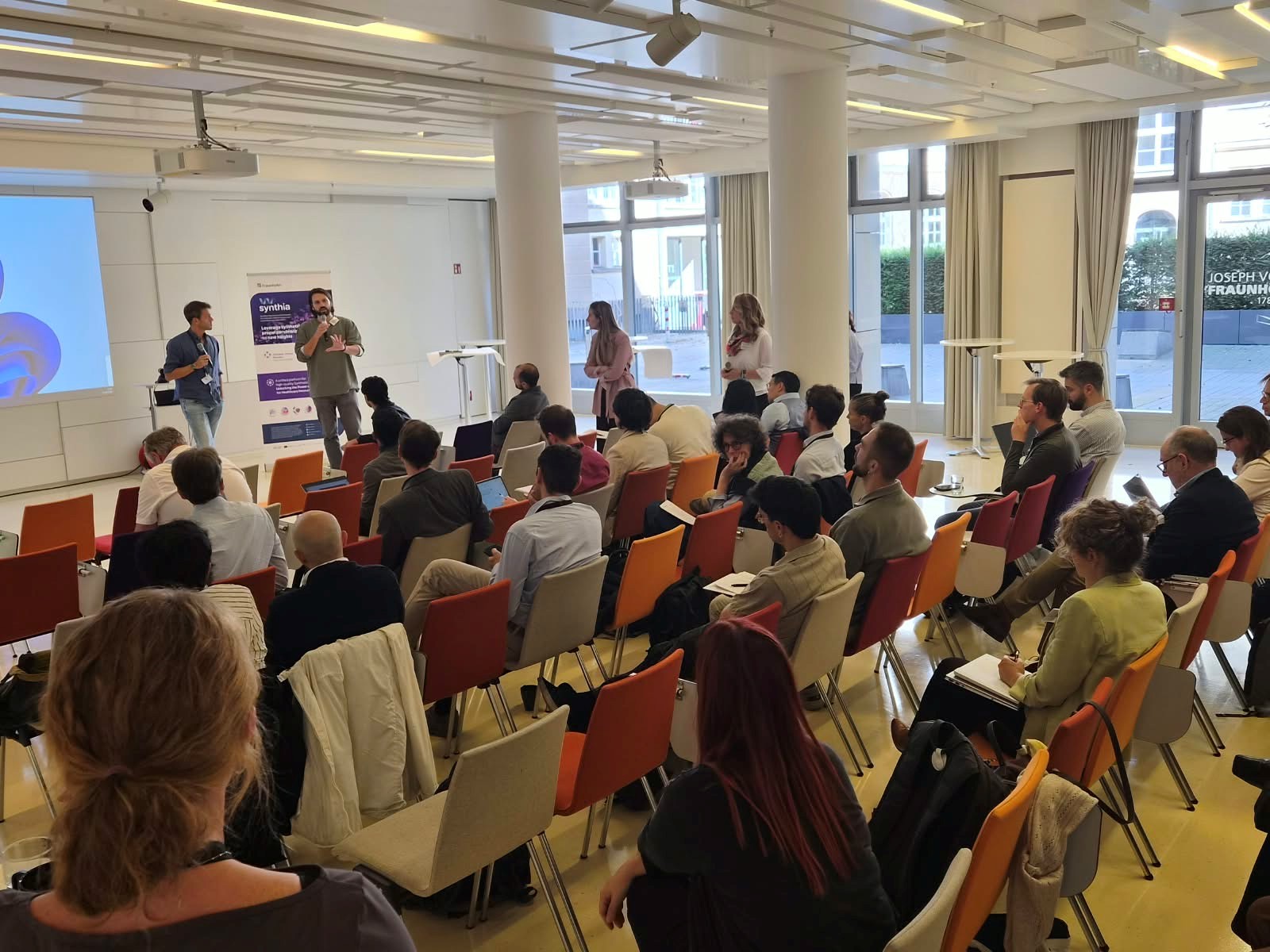
That question was at the heart of the SYNTHIA General Assembly 2026, which brought consortium partners together in Berlin on 22–23 September for two days of discussion, collaboration and joint planning. Hosted by SYNTHIA partners Fraunhofer and Gates Ventures, the meeting created space to look beyond individual tasks and Work Packages and consider the bigger picture: how data, synthetic data generation, evaluation, clinical needs, infrastructure, governance and sustainability need to connect if SYNTHIA is to demonstrate the value of synthetic health data in practice. And across the many breakout sessions and plenary discussions, a shared direction began to emerge.
From developing the pieces to connecting them
Over the first two years of SYNTHIA, partners across the consortium have been working on different parts of a complex challenge. Data needs to be identified, accessed and harmonized. Synthetic data generation methods need to be developed. Their quality, privacy and utility need to be evaluated. Models and results need somewhere to be shared and accessed. And throughout this process, SYNTHIA needs to remain connected to the clinical, regulatory, HTA and societal questions that determine whether these solutions can ultimately be useful.
In Berlin, many of these conversations came together. Discussions across the technical Work Packages highlighted the need for closer alignment between data, synthetic data generation, evaluation and the federated infrastructure. Questions around model access, metadata, privacy, storage and publishing are becoming increasingly concrete as technical developments mature.
This also means moving towards practical testing. Piloting the SYNTHIA Platform and its workflows emerged as an important next step: an opportunity not only to test technical components, but to demonstrate how they work together and identify where further decisions on access, governance and sharing are needed. At the same time, partners agreed that evaluating synthetic data cannot be separated from its intended use. Data that are suitable for one purpose may not necessarily be suitable for another. Fitness for use, utility, privacy and transparency therefore need to be considered together and in relation to specific applications.
The use cases are where the pieces meet
SYNTHIA's six clinical use cases are becoming increasingly important places to put these ideas into practice.
Breakout discussions in Berlin explored progress and next steps across lung cancer, breast cancer, Alzheimer's disease, multiple myeloma and type 2 diabetes, bringing together developers, data providers and clinical and patient perspectives.
The conversations showed both how much progress has been made and where common challenges remain.
In Alzheimer's disease, for example, work is advancing across synthetic image and tabular data generation, digital twin simulations and external synthetic control arms. In type 2 diabetes, discussions explored forecasting, multimodal and time-series data and opportunities to benchmark synthetic data generation methods. Lung and breast cancer discussions focused strongly on the foundations needed for reliable development and evaluation, including data harmonization, quality, reliability and fitness for use. Across the use cases, however, one need repeatedly surfaced: stronger connections between technical development and clinical expertise.
SYNTHIA’s use cases provide an important bridge between the project’s technical developments and the disease communities they are intended to support. By bringing clinicians and other disease experts together with developers, the use case teams can help ensure that synthetic data methods are shaped around relevant clinical questions, appropriate data and meaningful applications. At the same time, tangible results and examples will allow clinical experts to assess where synthetic data could offer real value within their respective disease areas.
Strengthening these connections within the use case teams and increasingly with the wider disease communities around them, will therefore be an important priority for the next phase.
"The IHI SYNTHIA project has made significant technical progress, although progress across use cases remains uneven, with data access continuing to pose major challenges. We have also worked intensively on defining SYNTHIA’s ultimate deliverables and long-term value. Important strategic decisions for the coming year include a stronger focus on synthetic control arms for clinical trials and a clearer scope for the future SYNTHIA platform, ensuring that it delivers tangible value to its users."
- Holger Fröhlich, Fraunhofer

"Being part of SYNTHIA’s lung cancer use case, Berlin was a great reminder of what collaborative science can achieve. Seeing clinicians, data scientists and industry partners align around a shared goal was genuinely encouraging. The discussions on data harmonisation and clinical validation gave me real confidence that we’re building something that can translate into meaningful value for patients. I left Berlin optimistic about where SYNTHIA is heading in its next phase"
- Athanasios Pouptsis, IISLaFe
.jpg)
Asking not only “does it work?” but “what is it useful for?”
As SYNTHIA moves forward, another question is becoming increasingly central: what will synthetic data actually enable us to do? This question ran through discussions on evaluation, clinical validation, regulatory science and HTA. Partners discussed the importance of moving towards practical demonstrations of synthetic data within the use cases and identifying realistic contexts in which SYNTHIA outputs could be assessed. For HTA and regulatory activities in particular, concrete examples will be essential for exploring how synthetic data might contribute to evidence generation and decision-making.
These conversations were complemented by perspectives from invited speakers Roland Eils (Berlin Institute of Health at Charité (BIH) / Fudan University Shanghai), Antoni Mestre Gascón (European Commission) and Gianmario Candore (European Medicines Agency, EMA), alongside a pharmaceutical industry perspective from SYNTHIA partner Dara Stein of BMS. Together, these discussions placed SYNTHIA's work within a much broader question facing the European health ecosystem: what evidence, safeguards and standards will be needed for people to confidently use synthetic data and AI in healthcare?
Building trust
The answer cannot come from technical development alone. Trust in synthetic data depends on understanding how data are generated, how privacy is protected, how quality and utility are assessed, and where these data can and cannot appropriately be used. This makes engagement with the people who may ultimately interact with or be affected by these technologies increasingly important.
As SYNTHIA enters its third year, we will therefore continue strengthening engagement with patients, clinicians, researchers, regulators, HTA bodies and other stakeholder communities. Disease-specific outreach will help connect individual use cases with the communities closest to them, while policy and stakeholder activities will create opportunities to test assumptions and gather perspectives on issues such as trust, governance and responsible use. The way SYNTHIA communicates its work will evolve alongside this. With tangible results beginning to emerge, the focus can increasingly move from explaining what SYNTHIA plans to do towards showing what is being developed, why it matters and how it could be used.
"Discussions at the SYNTHIA General Assembly in Berlin reinforced the importance of bringing patient perspectives into conversations about trust, validation and the future use of synthetic health data. While there is still progress to be made, I was encouraged by the openness of partners to strengthen patient involvement and by the emerging opportunities to make patient engagement a more integral part of SYNTHIA's activities. Looking forward to helping advance this work as SYNTHIA moves into its next phase"
- Eglys Gonzalez, Patvocates

Thinking beyond the lifetime of SYNTHIA
Berlin also prompted partners to look further ahead. If SYNTHIA succeeds in developing useful methods, models, infrastructure and guidance, how can these results continue to create value after the project ends? Discussions around sustainability explored the project's emerging service bundles, potential value propositions and different approaches to access and financial models, as well as alignment with the evolving European Health Data Space.
There was also a clear recognition that these questions cannot be answered by the consortium alone. Engaging other synthetic data projects, European initiatives and potential future users as well as the patient community will be important for understanding where SYNTHIA can add value and how its solutions could fit within the wider European health data landscape.
As we move into the next phase of our project, the priority will be connecting technical development with clinical need, generation with evaluation, infrastructure with access, and research outputs with the people and organizations that could ultimately use them. After two years of building the foundations, SYNTHIA is increasingly moving towards the next challenge: bringing those foundations together and demonstrating what synthetic health data can make possible.
.jpg)