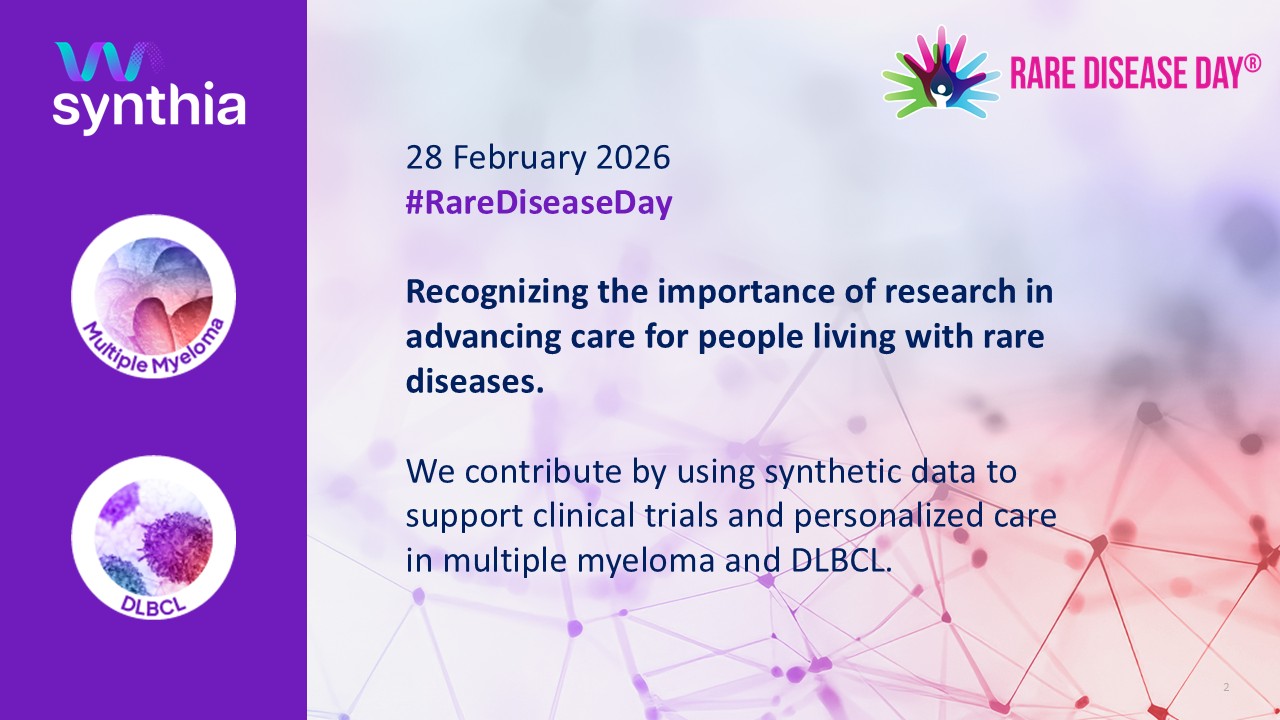

On Rare Disease Day, SYNTHIA highlights the urgent need for innovation in areas where limited data, small patient populations and complex trial design continue to slow progress.
Rare diseases affect millions of people worldwide, yet research is often constrained by fragmented datasets, privacy considerations and the difficulty of recruiting sufficient participants for clinical trials. For patients and families, this frequently translates into delayed diagnoses and limited treatment options.
At SYNTHIA, we are working to address these challenges through the responsible development and validation of synthetic data technologies.
Overcoming data scarcity in rare and complex conditions
In rare diseases, every data point matters. However, sharing sensitive patient information across institutions and borders can be difficult, particularly when patient numbers are small.
SYNTHIA’s consortium brings together academic and industry partners to generate high-quality, privacy-preserving synthetic datasets that replicate the complexity of real-world clinical data. These datasets allow researchers to test models, validate trial designs and explore new hypotheses without exposing identifiable patient information. By reducing barriers related to privacy, data access and small sample sizes, synthetic data can help strengthen evidence generation in areas where traditional approaches face limitations.
Supporting rare and hard-to-study hematological cancers
Two of SYNTHIA’s core use cases focus on rare and difficult-to-study blood cancers.
Multiple Myeloma
Synthetic data is used to create robust external control arms for clinical trials and to improve long-term outcome prediction by integrating clinical, imaging and genomic data. This approach supports precision medicine strategies and can help accelerate access to effective therapies.


On Rare Disease Day, we reaffirm our commitment to supporting research where it is needed most, helping enable better trials, better evidence and ultimately better outcomes for patients living with rare and complex conditions. For rare diseases, innovation must go hand in hand with responsibility. Synthetic data must be rigorously evaluated to ensure it is scientifically valid, ethically governed and aligned with patient interests.
Learn more about SYNTHIA’s work in oncology and synthetic data research on our impact and publications page.