

What does it take to turn healthcare data into reliable, trustworthy AI applications? And how can European initiatives work together to overcome the challenges standing in the way? These questions brought stakeholders from across the European health data ecosystem together in Paris, where SYNTHIA contributed its perspective on the opportunities and challenges of synthetic data.
On 5 October 2026, the SHAIPED Stakeholder Forum brought together representatives from healthcare institutions, industry, regulatory and Health Technology Assessment (HTA) bodies, Health Data Access Bodies (HDABs), and European research initiatives at ParisSanté Campus. Among the contributors was SYNTHIA Partner Ahmed Youssef Ali from Johnson & Johnson Innovative Medicine, who represented the project in discussions exploring how health data can be made fit for AI development, validation and evidence generation. The event provided an important opportunity to exchange practical experiences, identify common challenges and explore how complementary European initiatives can contribute to a more connected and effective health data ecosystem.
Is Healthcare Data Really Ready for AI?
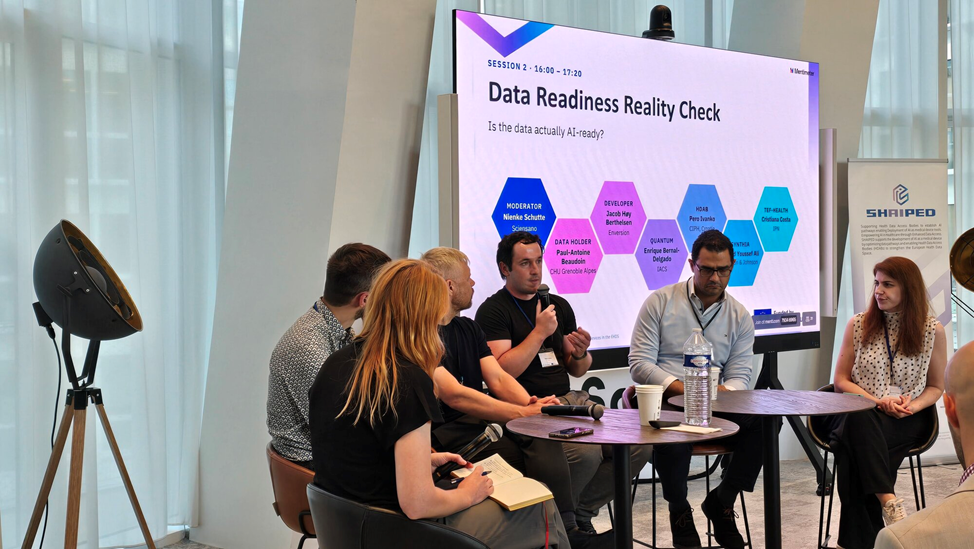
As artificial intelligence continues to open new possibilities for healthcare, access to high-quality, representative and reliable data remains one of the greatest challenges to its successful development and implementation. Healthcare data are primarily collected to support patient care, rather than AI research. As a result, researchers and developers often face fragmented datasets, inconsistent formats, incomplete information and complex requirements around data access and privacy. These challenges were at the heart of the Forum's session “Data Readiness Reality Check: Is the Data Actually AI-Ready?”, moderated by Nienke Schutte from Sciensano. Bringing together perspectives from hospitals, industry and European research initiatives, the session explored practical experiences with the secondary use of health data for AI development and evidence generation. A recurring message emerged throughout the discussions: having access to data does not necessarily mean those data are ready to support trustworthy AI applications. Participants highlighted the considerable effort required to prepare healthcare datasets, the importance of harmonization and interoperability, and the need for technical infrastructures capable of supporting AI development while protecting sensitive patient information.
Bringing SYNTHIA's Perspective to the Discussion
A key contribution came from SYNTHIA Partner Ahmed Youssef Ali, who joined the session to share insights into the potential of synthetic data and the importance of evaluating its quality and reliability.
Within SYNTHIA, a multidisciplinary consortium of 39 partners is working to develop and validate synthetic data generation tools and methods across six clinical use cases. By generating artificial datasets that preserve relevant characteristics of real-world health data, synthetic data offers promising opportunities to support healthcare research and AI development while addressing some of the limitations associated with accessing sensitive patient information.
However, as Ahmed emphasized during the discussion, generating synthetic data is only part of the challenge. Ensuring that these data are trustworthy and fit for their intended purpose is equally important.
His contribution highlighted four essential dimensions of synthetic data evaluation: privacy, utility, fidelity and bias. Together, these considerations help determine whether synthetic datasets adequately protect patient information, preserve relevant characteristics of the original data and can meaningfully support their intended research or healthcare applications.

The discussion also acknowledged that synthetic data is not a universal solution. While it can create valuable opportunities for research and early-stage AI development, its limitations must be carefully understood, particularly when applications require evidence reflecting the complexity of real-world clinical environments. These exchanges closely align with SYNTHIA's broader ambition: moving beyond synthetic data generation alone towards establishing robust approaches for evaluating and validating synthetic datasets, ultimately supporting their responsible use in healthcare innovation.
Connecting European Initiatives to Advance Healthcare AI
Beyond the technical discussions, the Forum demonstrated the importance of bringing together initiatives working on different but closely connected aspects of Europe's evolving health data ecosystem. SHAIPED (Supporting Health Data Access Bodies to establish AI pathways enabling Deployment of AI as medical device tools) focuses on strengthening the pathways through which health data can support the development of AI-based medical devices. By optimizing data access processes and supporting Health Data Access Bodies, the initiative contributes to the implementation of the European Health Data Space (EHDS).
While SHAIPED works to improve the conditions and infrastructure for accessing and using health data, SYNTHIA focuses on advancing synthetic data generation and validation to support trustworthy AI applications. These complementary approaches offer valuable opportunities for knowledge exchange and collaboration, particularly around shared challenges such as data quality, privacy, interoperability and fitness for purpose. By bringing together perspectives from different European initiatives, the Stakeholder Forum helped connect technical developments with the practical realities of healthcare data access, regulatory requirements and clinical implementation.
Working Together Towards Better Outcomes for Patients
The discussions in Paris reinforced an important message: advancing AI in healthcare requires more than technological innovation alone. It depends on collaboration across disciplines, institutions and initiatives to ensure that new solutions are reliable, clinically meaningful and capable of addressing real healthcare needs.
For SYNTHIA, engaging with initiatives such as SHAIPED is an important opportunity to share knowledge, learn from complementary approaches and contribute to a more coordinated European health data ecosystem. As healthcare AI continues to evolve, strengthening these connections will be essential to bridging the gap between research and real-world implementation. Ultimately, by combining expertise and addressing shared challenges together, European initiatives can help accelerate the development of trustworthy AI solutions, advance personalized medicine and create meaningful improvements in healthcare and patient outcomes.