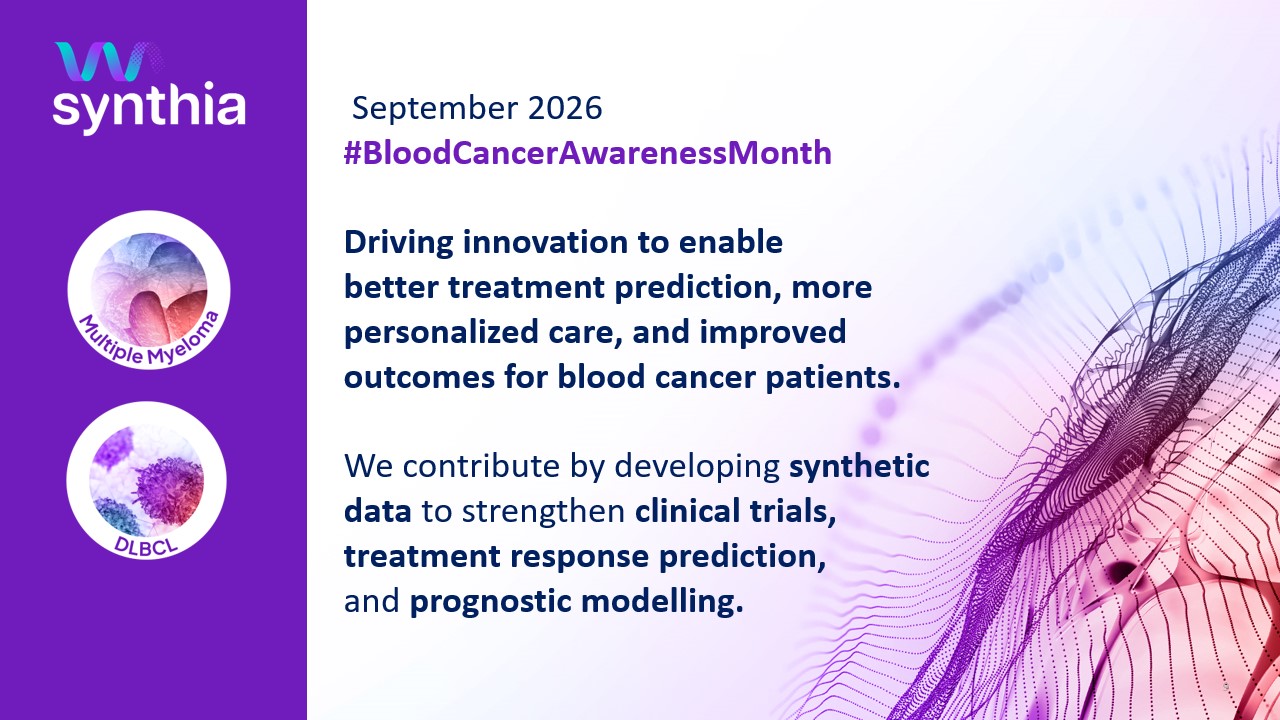

During Blood Cancer Awareness Month, SYNTHIA joins the global community in raising awareness of blood cancers and highlighting the importance of continued research and innovation to improve treatment and outcomes for patients.
Blood cancers encompass a diverse group of diseases affecting the blood, bone marrow and lymphatic system. Despite significant advances in diagnosis and treatment, challenges remain in predicting how individual patients will respond to treatment, understanding disease progression and generating robust evidence for new therapies.
At SYNTHIA, two of our six clinical use cases focus specifically on blood cancers: Diffuse Large B-Cell Lymphoma (DLBCL) and Multiple Myeloma (MM).
Addressing Data Challenges in Blood Cancer Research
DLBCL and Multiple Myeloma are complex and heterogeneous diseases. Differences between patients, disease characteristics, treatment pathways and outcomes can make it challenging to generate the evidence needed to develop and evaluate new therapies.
Clinical trials can also face challenges in establishing suitable control groups, particularly in specific patient populations or later-line treatment settings. At the same time, developing reliable models to predict disease progression and treatment response requires access to diverse, high-quality data spanning multiple modalities.
Synthetic data offers a promising approach to help address these challenges by generating artificial data that reflect important characteristics and patterns of real-world data while supporting patient privacy.
Within SYNTHIA, researchers are investigating how synthetic data can complement existing clinical and real-world data to strengthen clinical research and support more personalized approaches to blood cancer treatment.
The SYNTHIA DLBCL Use Case

Diffuse Large B-Cell Lymphoma (DLBCL) is the most common form of non-Hodgkin lymphoma, accounting for approximately 30–40% of cases. While effective first-line treatments are available, some patients experience relapse or develop refractory disease, creating an ongoing need for new treatment options and better ways to predict outcomes.
Through its DLBCL use case, SYNTHIA is investigating how synthetic data can contribute to both clinical trial design and treatment response prediction. The research focuses on several key areas:
- Generating synthetic data to strengthen external control arms for clinical trials, with validation against retrospective real-world data.
- Developing and validating prognostic models based on Minimal Residual Disease (MRD), an important indicator for assessing treatment response and forecasting patient outcomes.
- Exploring whether synthetic data can support the segmentation and identification of lesions by improving the pre-training of AI models.
- Expanding available DLBCL cohorts and investigating how synthetic data can help account for treatment-related variability when assessing the significance of MRD.
The use case brings together multiple data modalities, including MRD data, clinical and laboratory results, demographics, treatment information and PET-CT imaging. Ultimately, the research aims to improve disease monitoring and treatment response prediction while demonstrating how synthetic data could strengthen external control arms and support evidence generation for new therapies.
The SYNTHIA Multiple Myeloma Use Case

Multiple Myeloma (MM) is the second most prevalent haematological cancer. While advances in treatment have significantly improved outcomes and many patients can manage the disease for years, Multiple Myeloma remains incurable. Its considerable genetic diversity and the presence of high-risk features in some patients also continue to present challenges for treatment and research.
SYNTHIA's Multiple Myeloma use case is investigating how synthetic data can help create external control arms and improve long-term outcome prediction, contributing to the development of more personalized approaches to treatment. Our work focuses on:
- Evaluating how accurately synthetic data can reproduce clinical characteristics and outcomes observed in clinical trials and real-world datasets.
- Exploring the integration of genomic, clinical, demographic, therapeutic and imaging data into synthetic datasets.
- Investigating the impact of rare, high-risk genetic alterations on the prediction of clinical outcomes through synthetic genomic data generation.
- Assessing the potential of synthetic external control arms to contribute evidence for regulatory and Health Technology Assessment decision-making.
The use case draws on a broad range of data, from demographics, laboratory tests, treatment information and MRD to PET-CT imaging, cytogenetics, DNA sequencing and other genomic data. By bringing these different data sources together, the research aims to explore how synthetic data can strengthen clinical trials, improve predictive modelling and contribute to precision medicine in Multiple Myeloma.
From Better Data to Better Decisions
Across both DLBCL and Multiple Myeloma, SYNTHIA is exploring how synthetic data can help researchers make better use of complex, multimodal health data and generate stronger evidence for the development and evaluation of new treatments. A shared focus is the potential of synthetic data to strengthen external control arms in clinical trials. This could be particularly valuable when conventional randomized control groups are difficult to establish or when rapidly evolving treatment pathways make existing comparator data less representative of current clinical practice.
At the same time, synthetic data could support the development of more robust prognostic and predictive models. In DLBCL, this includes exploring MRD as an indicator of treatment response and survival, while in Multiple Myeloma, research is investigating how clinical, imaging and genomic information can contribute to improved long-term outcome prediction.
During Blood Cancer Awareness Month, we highlight the importance of continued research, collaboration and responsible data innovation to advance our understanding of these complex diseases.
Through SYNTHIA, we are working towards a future where trustworthy synthetic data can help strengthen clinical research, support more personalized approaches to treatment and, ultimately, contribute to better outcomes for people affected by blood cancers.
- Learn more about SYNTHIA's work across our six clinical use cases.
- Discover more about SYNTHIA's synthetic data research on our impact and publications page.
- Read more about how ethical, legal and societal considerations are incorporated into SYNTHIA's engagement with citizens and patients here.